Custom 3D configurator vs platform subscription: what you really pay
Compare platform subscription fees with a custom 3D configurator over three years, including setup, ownership and ongoing costs.
Short answer
Compare the custom build fee with platform licence fees over the same one to three year period, and include implementation, hosting, support and change costs on both sides. Check what you keep if you leave. At VividWorks Pro's published US$1,047 per month, licence fees pass a US$24,000 build in about 23 months.
A configurator can look excellent in a demo and still leave your team doing the same work after an enquiry arrives: checking dimensions, correcting incompatible options and rebuilding the quote by hand.
That is the first thing to settle before comparing a platform subscription with a custom build. What should the configurator take off your team's desk?
For a made-to-order manufacturer, the answer might be a valid product specification, a priced enquiry or a bill of materials. A rotating 3D model is only one part of that job.
We build custom configurators, so we have a clear perspective. But a subscription can be a sensible purchase. The useful comparison is what each route delivers, what it costs to keep working and what you can take with you if you leave. For the wider decision, see our build vs buy guide.
Start with the handoff, not the viewer
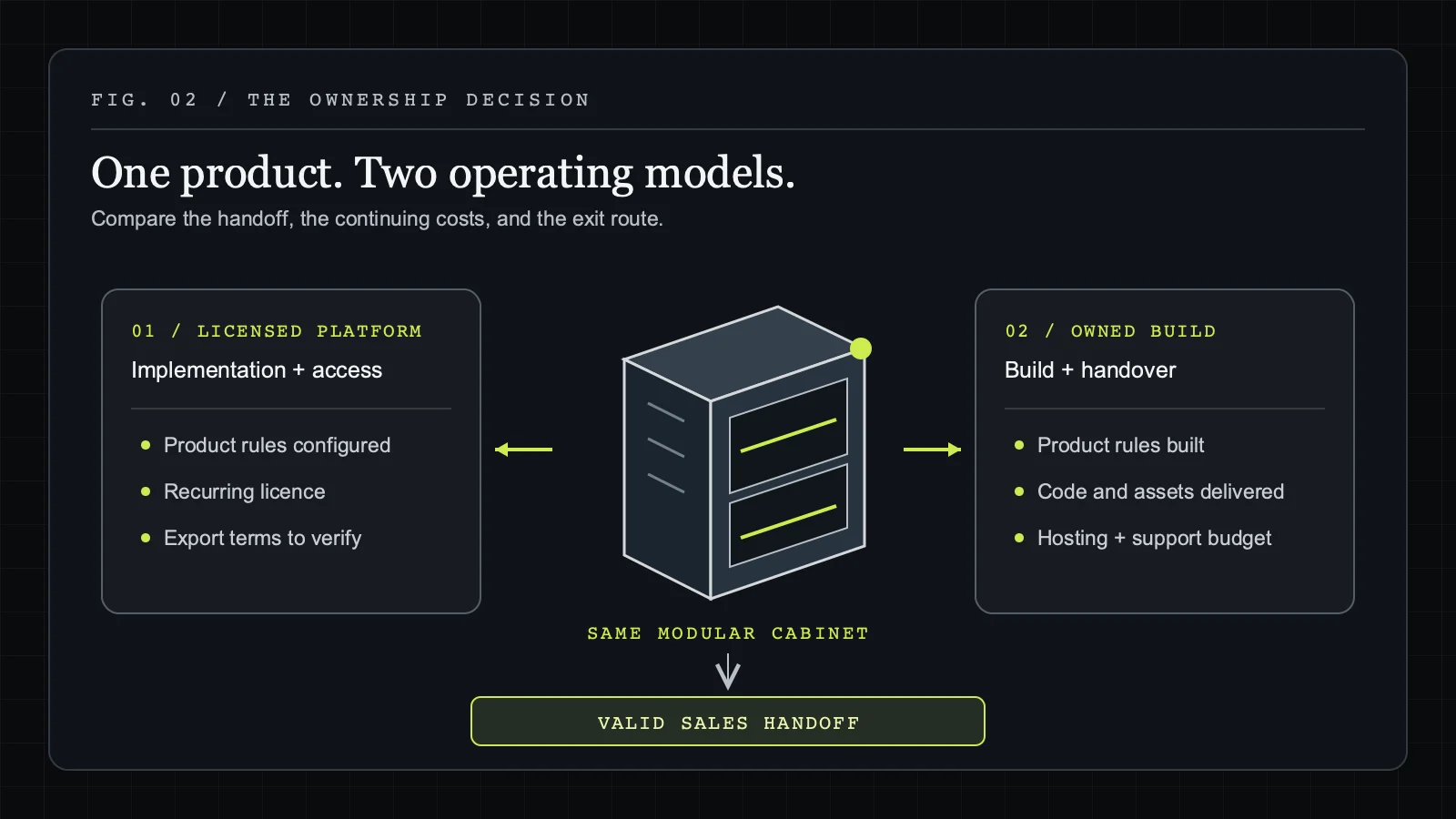
Imagine a manufacturer selling modular cabinets. A customer chooses a width, a finish and a drawer layout. The image updates immediately.
Now ask what happens next.
Can that width accept those drawers? Does the price include the selected finish? Does the enquiry carry the exact configuration, or does someone have to interpret a screenshot? Can the workshop use the output?
Both a platform and a custom build may handle these requirements. Neither does so simply because it renders a product in 3D. The work lies in modelling the product rules and connecting the result to your sales process.
Before requesting prices, write one sentence that describes a successful handoff. For example: “Sales receives a configuration that has already passed our product rules, with the selected dimensions, options and price attached.”
Use that same sentence in every brief. It gives you something more useful to compare than a feature checklist.
A platform licence is not the implementation
There are three broad routes, and mixing them produces misleading cost comparisons.
- A self-serve tool: your team configures the product and manages the integration. This can work well for straightforward products with a small option set and a simple checkout.
- A platform with implementation services: a vendor or partner sets up the product, rules and connections on a licensed platform. You pay for the implementation as well as ongoing access.
- A custom build: a developer builds the agreed experience and hands over the source code and project assets under your contract. Hosting, support and later changes still need a budget.
A low self-serve subscription is not a substitute for a quote to model a complex product range. Equally, a custom project should not be presented as “everything included forever” because its initial invoice is larger.
What published platform prices tell you
The figures below were checked on 27 October 2026. They show cumulative base licence fees after one, two and three years, assuming the listed rate stays unchanged. They are not complete project quotes. Implementation, modelling, integrations, additional usage and taxes can change the amount you actually pay.
| Published plan | Pricing basis | After 1 year | After 2 years | After 3 years |
|---|---|---|---|---|
| VividWorks Pro | US$1,047 per month | US$12,564 | US$25,128 | US$37,692 |
| Expivi | Quote required | Obtain a quote | Check contract and renewal terms | Check contract and renewal terms |
Scroll sideways to compare all columns.
VividWorks publishes its Pro plan for modular products, with 1,000 3D assets and 120,000 annual views. Setup and implementation are scoped separately. Its Starter plan, at US$547 per month, targets less complex products, so Pro is the more relevant starting point for this modular-product example. VividWorks is the only vendor here that publishes a price; Expivi is quote-only.
The two plans use different allowances and pricing models. The rows are useful budget references, not a claim that the products or deliverables are interchangeable.
Expivi's licence policy refers to the applicable subscription plan and rates; obtain a written quote for your scope. It also sets out an initial 24-month term, automatic renewal for another 24 months and annual indexation provisions. Confirm the terms that apply to your quote. There is no defensible public dollar figure to insert into this table just to make it look complete. For a dated comparison of named platforms, see custom 3D configurator vs Threekit and Expivi.
Put the custom build beside the recurring fee
Our published custom-build pricing currently starts at US$7,000 for Starter, US$14,000 for Professional and US$24,000 for Enterprise. The right tier depends on scope. A platform's plan name does not map directly to one of those tiers. For what drives those prices, see how much a 3D product configurator costs.
To make the arithmetic concrete, take a custom project quoted at US$24,000 and compare its initial build fee with VividWorks Pro's published base subscription:
| Cost component | After 1 year | After 2 years | After 3 years |
|---|---|---|---|
| Custom build, US$24,000 agreed initial scope | US$24,000 | US$24,000 | US$24,000 |
| VividWorks Pro base licence, unchanged rate | US$12,564 | US$25,128 | US$37,692 |
Scroll sideways to compare all columns.
This compares two cost components, not total ownership costs. The custom row excludes hosting, maintenance and subsequent changes. The platform row excludes setup, implementation and other charges. You need quotes for those missing items before making a purchasing decision.
At that subscription rate, cumulative licence fees reach US$24,000 after about 23 months: US$24,000 divided by US$1,047. By the end of year one, the licence fees are still below the custom build fee. By the end of year two, they are above it.
That is a spending crossover, not proof of business payback. Payback depends on what the configurator does for your operation, including any time saved or additional profitable orders. Those results need to be measured in your business, not borrowed from somebody else's case study.
Platform implementation fees can bring the crossover forward. Custom hosting, support and changes can push it back. A smaller custom scope changes it again. An honest comparison keeps all of those inputs visible.

What does “you own it” actually mean?
Ownership should be a handover you can inspect.
For a custom project, the contract should spell out delivery of the source code, the product assets and their licences, the configuration rules, and the documentation another developer would need to run it. Hosting and deployment access matter too. A folder of code is not much use if the only working deployment sits in an account you cannot access.
Ownership also does not cancel maintenance. Dependencies change, browsers change and your product range changes. The practical benefit is the ability to choose who does that work and where the application runs, subject to the licences and services used in the build.
For a platform, ask a different set of questions: can you export your original models, materials, configuration data and customer-generated specifications? Which product rules are portable? What stops working when the contract ends?
For example, Expivi's published licence policy says access ceases on termination. That makes the exit plan worth discussing before signing. It does not, by itself, tell you which of your assets are exportable; ask for that answer separately and in writing.
When the subscription earns its place
Choose a platform when its existing capabilities fit your products, your team values its management tools, and the implementation quote gets you to a useful launch on acceptable terms.
Recurring fees can buy useful ongoing service. Ask exactly what the proposed plan includes: support, hosting, updates, usage allowances and responsibility for fixing integration failures. There is a difference between paying for a service your team uses and paying merely to keep an old implementation accessible.
A custom build is worth considering when the product rules or quoting process need substantial bespoke work anyway, when control over the experience matters, or when you want the option to move development and hosting later.
If your products are simple and your team can do the setup, a self-serve tool may be the better purchase. Paying for bespoke development makes sense when it solves a problem the simpler route leaves behind.
Ask for the same three-year worksheet
Send every supplier the same scope, then ask them to separate:
- Launch costs: modelling, materials, product rules, interface work, integrations and training.
- Recurring costs: licences, hosting, support, usage charges and any minimum commitment or annual increase.
- Change costs: adding a product, updating a price list, changing a rule and replacing an integration.
- Exit deliverables: assets, code where applicable, data exports, documentation and access you retain.
Have them show year one, year two and year three. Keep each currency separate until you choose an exchange-rate assumption, and compare the same tax basis. Leave an unknown as “quote required”; do not turn it into zero.
You will then be comparing two ways to deliver a working sales tool, with their ongoing obligations visible.
If you want to explore the custom route, send us your product range and the handoff you need. We can help define a useful starting scope. The US$2,500 Pilot is a smaller first step and is credited in full toward a full build within six months. Email is the starting point; a call is optional.
Frequently asked questions
When do subscription fees overtake a custom 3D configurator build?
What does a published platform price leave out?
What does owning a custom configurator include?
When is a platform subscription the better choice?
How can platform and custom quotes be compared fairly?
Have a product like this?
Email us the details. We'll map out what a configurator could do for your product, zero obligation.