Skip to content
3dconfigurator.dev

Work / Trailers & Industrial

Trailer Configurators for Manufacturers and B2B Equipment Builders

Trailers are bought on specification, not colour. A trailer configurator lets operations and fleet buyers set every attribute themselves (dimensions, floor, wheels, steering, coupling, bodywork), see the result in 3D, and send you a quote request you can price without a scoping call.

01The Problem

Trailer specs get lost between the buyer and the quote

A buyer who needs a 10-ton forklift trailer with a steel tread plate floor, solid rubber wheels, turntable steering and fencing on three sides knows exactly what they want. Getting that across usually takes a phone call, a PDF spec sheet, a few emails and a revised quote, and every round of "did you mean the kingpin or the turntable?" adds days to a sales cycle that's already long.

Meanwhile, the buyers still researching have nothing to engage with. They can read spec sheets and browse a gallery, but they can't see their trailer, configured for their site, before talking to sales. In a sector still sold through catalogues, trade shows and relationships, the manufacturer that lets an engineer spec a trailer at 7am, before anyone is in the office, has an edge.

A trailer configurator turns your spec sheet into a visual tool. Every attribute changes the 3D model: floor surfaces swap, walls and gates appear, and the undercarriage changes with the steering system. The buyer confirms the spec visually as they build it, and the quote request that reaches you is complete, unambiguous and comes with a picture.

02Your Options

Your options for a trailer configurator

Trailer and equipment manufacturers typically choose between three routes. Which one fits depends on your existing website, the depth of your options, and whether you build to a configured spec or engineer every order.

01

PDF spec sheets and an enquiry form

Downloadable specs per model, with a form or phone number for quotes.

Best for
Very small ranges, or products that always need an engineering survey before quoting.
Trade-off
Buyers can't validate their own spec, misunderstandings surface at quote stage, and sales spends its time scoping instead of closing.

02

A 3D platform integrated into your site

A hosted 3D configure-price-quote engine such as Expivi, with the integration built into your existing website.

Best for
Sites already on WordPress or WooCommerce that need a fast launch. Hulck's configurator was built this way, in under a month.
Trade-off
A platform licence alongside the build, and option logic limited to what the platform models well.

03

A custom configurator you own

Your attributes, dependency rules and pricing in code, rendered in Three.js, hosted where you choose.

Best for
Deep option trees, rules a platform can't express, integrations with ERP or dealer systems, or no appetite for a recurring licence.
Trade-off
More engineering up front, typically Professional ($14,000) or Enterprise ($24,000) scope. A $2,500 Pilot on one model shows whether buyers use it.

Weighing a platform against a custom build? Read the build-vs-buy breakdown.

03Integrations

From configured trailer to quote

B2B configurators live or die on the handoff to sales and production.

WordPress and WooCommerce

Embedded natively in your page templates, following WordPress hooks and coding standards, so the configurator keeps working as WordPress updates roll out, as it has on hulck.com.

Quote requests with renders

Every request carries the full spec plus a 1920×1080 render of the configured trailer, so sales sees exactly what was specified.

Your sales workflow

Quote requests routed into whatever your team already uses: a sales inbox, a CRM, or both.

Pricing or quote-only

List prices and option surcharges shown live where you want them, or kept off the page with the configurator collecting specs only.

Spec export for production

A structured spec your engineering or ERP team can import, instead of re-keying it from an email.

04Case Study

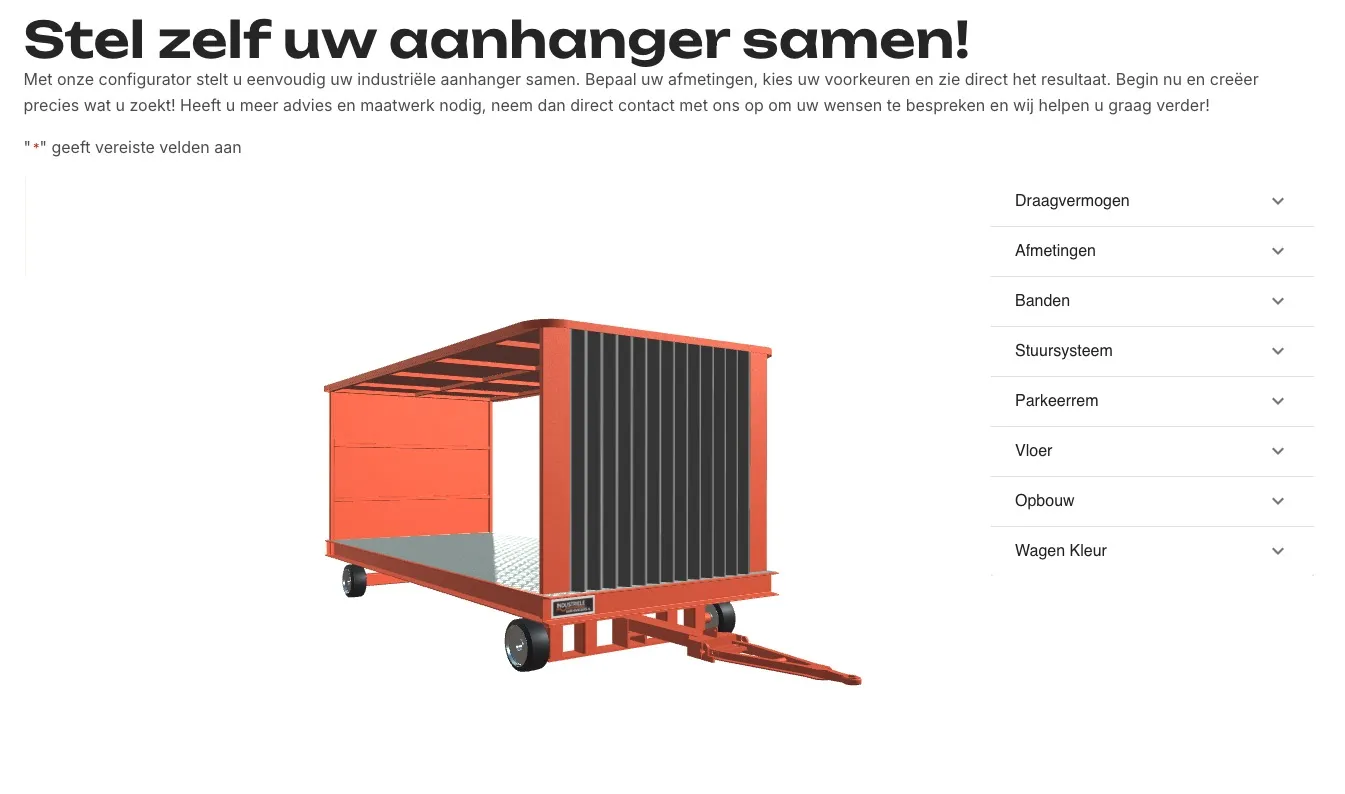
Hulck's industrial trailer configurator

Hulck: 3D Industrial Trailer Configurator screenshot
Delivered
Under a month, extended since
Scope
23+ configurable attributes
Stack
Expivi · WordPress · WooCommerce
Output
Quote request + 1920×1080 render

Hulck · NL

Hulck builds heavy-duty industrial trailers in the Netherlands, including forklift trailers, roll trailers rated to 200 tons, electric platform wagons and logistic train systems, for clients such as Tata Steel, ArcelorMittal and Scania. Every trailer is built to specification, and the specification has dozens of variables.

We set up the full product configuration in Expivi, mapping 23+ attributes to geometry swaps, material changes and optional components, and built the integration layer that runs it natively inside Hulck's WordPress and WooCommerce site. Buyers choose dimensions, load capacity, floor type, wheels and tyres, steering, coupling, walls, gates, tarpaulins, rails, lighting and colour, rotating the trailer in 360° as they go.

When the spec is done, the configurator captures a 1920×1080 render and attaches it to the quote request alongside the full specification. The first version shipped in under a month, and we've kept extending it as Hulck adds trailer types and options.
05FAQ

Trailer configurator FAQ

How much does a trailer configurator cost?
It depends on the number of models and attributes and where quotes go. One trailer model with its key options as a working 3D configurator fits our $2,500 Pilot. A full configurator with dozens of attributes, dependency rules and quote handoff is typically Professional ($14,000); adding an admin for products and pricing, or ERP integration, moves it to Enterprise ($24,000).
How long does it take to build a trailer configurator?
Hulck's first version, built into an existing WordPress site on a 3D platform, launched in under a month. A custom-built configurator for one or two trailer models usually takes 4–8 weeks, longer with a pricing engine or ERP integration, and a Pilot on one model is live in about two weeks.
Can it show prices, or only collect quote requests?
Either. Many B2B manufacturers keep prices off the page and use the configurator to collect complete specs; others show list prices that update live with every option. You decide per product.
Do we need 3D models of our trailers?
No. We can work from your CAD, drawings or photos. CAD speeds things up, but it always needs simplifying for the web, because a production assembly is far too heavy for a browser on a site manager's phone.
Does it work for equipment other than trailers?
Yes. The same approach fits machinery, material-handling equipment, racking, vehicle bodies and modular units: any B2B product where buyers specify from a list of interdependent options and the quote process currently runs on PDFs and phone calls.

Turn your spec sheet into a configurator

Send a link to a trailer model, its spec sheet and the options buyers ask about most. We'll reply by email within 24 hours with how a configurator would work for it, and what it would cost.

Not ready for a full build? Explore the Pilot: One product as a live 3D configurator in about two weeks. The full $2,500 is credited toward a full build within 6 months.