Skip to content
3dconfigurator.dev

Work / Furniture

Furniture 3D Configurators for Made-to-Order Brands

A furniture 3D configurator lets a customer set the size, wood, legs and finish of a made-to-order piece, see it in real time, check the price, and place it in their own room, before you cut a single board. Here's how we build them, and one we shipped.

01The Problem

Made-to-order furniture is hard to buy from a photo

A customer who wants a 220×100cm oval dining table in herringbone oak, 4cm thick, on X-frame steel legs won't find that table in your gallery. It doesn't exist yet. They're asked to imagine it from a swatch, a photo of somebody else's table and a price list, then pay a deposit and wait weeks for a piece that's made to order and can't be returned.

That gap between what the customer pictures and what arrives is where furniture sales stall. It shows up as abandoned product pages, email threads asking what it would look like in walnut, and a sales inbox hand-pricing combinations a web page could have priced instantly. The more options you offer (shapes, sizes, woods, tops, bases, finishes, upholstery), the less any photo shoot can keep up.

A furniture 3D configurator closes that gap. Every option the customer picks redraws the piece in real time: the grain changes, the top thickens, the legs swap, and the price updates alongside. On a phone, AR drops the configured piece into the room at actual size, which answers the question no render can: will it fit? The customer stops imagining and starts specifying, and the order that reaches you is complete.
02Your Options

Your options for a furniture 3D configurator

There are three realistic ways to put configurable furniture online. We've shipped on both sides of the build-versus-buy line, so here's the honest version.

01

Photos, swatches and a quote form

Show finished pieces, list the options, and price by hand when the enquiry arrives.

Best for
Small ranges with few combinations, or brands that sell mostly through a showroom.
Trade-off
Every combination you can't photograph is a guess for the customer and a manual quote for you.

02

A configurator SaaS platform

Platforms like Expivi host the 3D models, materials and AR, and you embed their viewer in your store.

Best for
When speed matters and the platform's features match your product: a furniture client's configurators run on Expivi inside WooCommerce.
Trade-off
A monthly licence for as long as the configurator is live, and an experience bounded by what the platform supports.

03

A custom configurator you own

Hand-coded in Three.js and React Three Fiber, running on your hosting, with your pricing rules in code.

Best for
Parametric shapes, modular systems, a UI that has to feel like your brand, or when you want to stop paying rent.
Trade-off
A larger upfront build: Starter ($7,000) for one product with material options, Professional ($14,000) once it needs a pricing engine and checkout. The $2,500 Pilot tests it on one product first.

Weighing a platform against a custom build? Read the build-vs-buy breakdown.

03Integrations

From configurator to checkout

A configurator that ends in a screenshot is a toy. The configured piece has to reach your cart, your workshop and your inbox with every option intact.

WooCommerce

The configured piece goes into the cart with its full spec and the configurator's price, which is the price at checkout. This is how a furniture client's tables and chairs sell, deposit terms included.

Shopify

The spec travels as line-item properties; the configured price reaches checkout through variants mapped to your price steps or a draft order, depending on how your pricing works.

Your price list, encoded

Base price by size plus surcharges per wood, thickness and base, encoded once from your spreadsheet so the configurator and your quotes never disagree.

AR view-in-room

On a phone, the configured piece opens in the camera at true scale, so the customer checks the fit before they order.

Workshop-ready specs

Every order carries dimensions, material, thickness, base and finish, formatted for whoever builds it.

Quote requests

For pieces you quote rather than sell outright: the spec and a screenshot emailed to sales, or posted to your CRM.

04Case Study

A furniture client's table and chair configurators

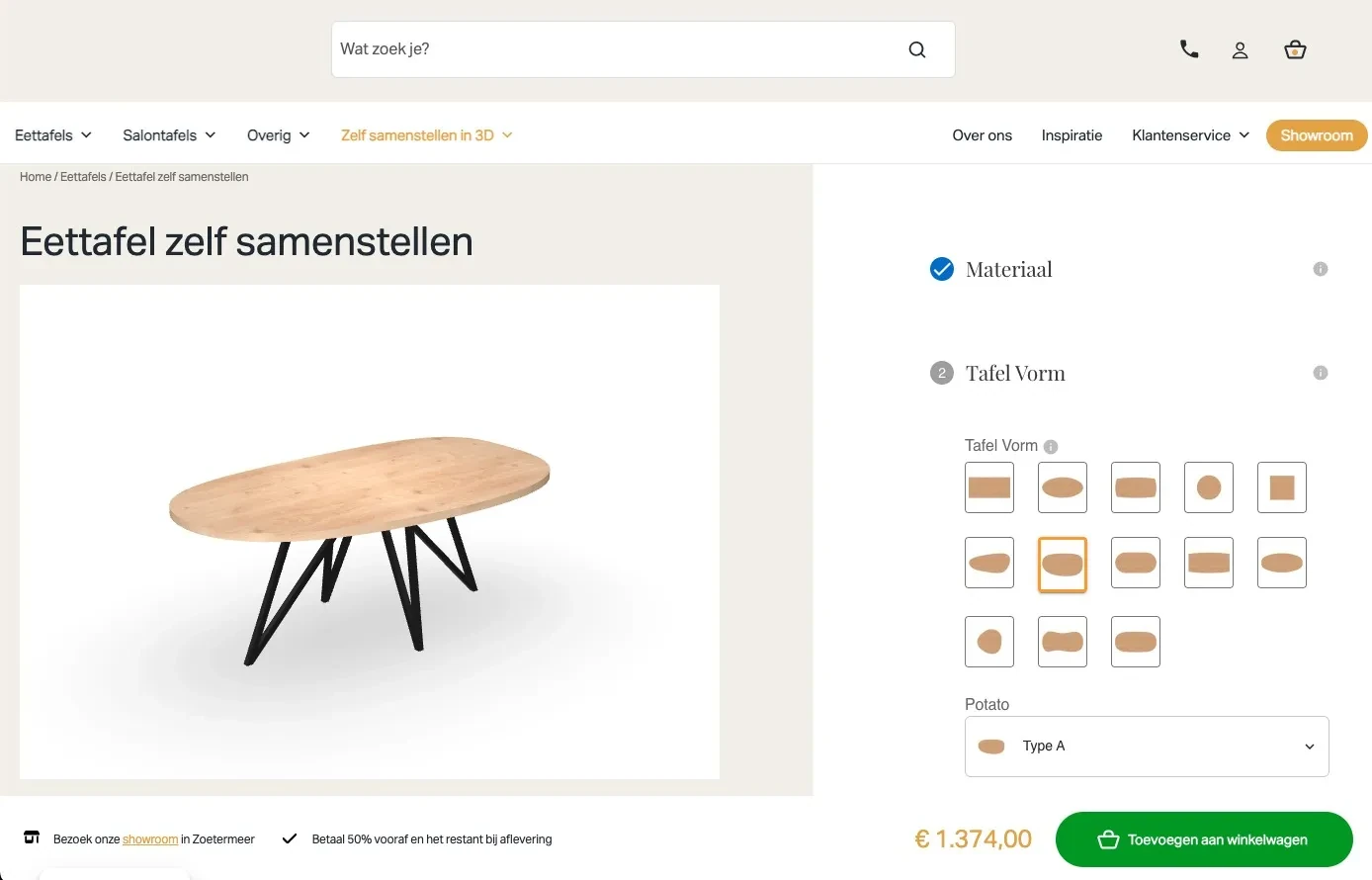
Furniture client: 3D Furniture Configurator screenshot
Delivered
First configurator in under a month
Scope
3 configurators: dining, coffee, chairs
Stack
Expivi · WordPress · WooCommerce
Highlights
Live pricing · AR · cart integration

Furniture client · NL

A furniture client makes custom oak dining tables, coffee tables and chairs in the Netherlands, sold direct-to-consumer from a showroom in Zoetermeer and online. Customers choose shape, wood (solid, herringbone or lived-in oak), dimensions, tabletop thickness, steel base style and finish, then wait 6–8 weeks for a piece made to their order.

We built three configurators (dining tables first, then coffee tables, then chairs) on Expivi's 3D engine, integrated into a furniture client's WordPress and WooCommerce store. Every selection updates the 3D model and the live price, AR places the configured table in the customer's room at actual size, and the finished configuration goes straight into the WooCommerce cart with its full spec, through the normal checkout and 50% deposit flow.

The first configurator shipped in under a month. Because the integration layer was built once, each new product category launched faster than the last. That's the clearest argument for starting with your best-seller and expanding from there.

05FAQ

Furniture 3D configurator FAQ

How much does a furniture 3D configurator cost?
It depends on how many products and options you have and where the order goes afterwards. A single piece with material and finish options and live pricing fits our $2,500 Pilot, live in about two weeks. A configurator with more products and material options but no checkout fits Starter ($7,000); add size inputs, a pricing engine and cart integration and it's Professional ($14,000); a multi-product range with an admin for managing prices is Enterprise ($24,000). Our fee is one-time. A custom build has no monthly licence at all; a build on a platform like Expivi adds the platform's own subscription.
Do I need 3D models of my furniture?
No. We model from your photos, drawings or CAD files, and optimise the models so they load fast on a phone. CAD speeds things up, but it still needs converting and lightening, because production CAD is far too heavy for a browser.
Can customers enter custom dimensions?
Yes. Tables, desks, cabinets and shelving can scale parametrically, so a customer can type 220×100cm and see exactly that, with legs, rails and joints repositioning correctly rather than stretching. Limits, step sizes and price-per-size rules come from your workshop's real constraints.
Does it work with WooCommerce or Shopify?
Yes. The configured piece goes into the cart with its full specification and the price shown in the configurator. A furniture client's configurators run inside WooCommerce. Shopify needs one extra step: line-item properties carry the spec, and the configured price reaches checkout through price-mapped variants or a draft order.
Can customers see the furniture in their own room?
Yes. AR view-in-room is part of our Professional tier. On a phone, the configured piece opens in the camera at true scale, which answers the question a render can't: will it fit?

See your best-selling piece in 3D

Send a product link or a few photos, your options and how they affect the price. We'll reply by email within 24 hours with what a configurator for it would look like, and what it would cost.

Not ready for a full build? Explore the Pilot: One product as a live 3D configurator in about two weeks. The full $2,500 is credited toward a full build within 6 months.